Best Energy Gels for Long Bike Rides: 60g, 90g and 120g Carb Strategies
You are not asking what a gel is. You are asking what to actually carry for four, five or six hours in the saddle. Built around carbohydrate targets per hour, not an editorial ranking.
- best energy gels for long rides
- energy gels for long bike rides
- cycling nutrition long ride
- 90g carbs per hour cycling
- 120g carbs per hour cycling
- carb strategy long bike ride
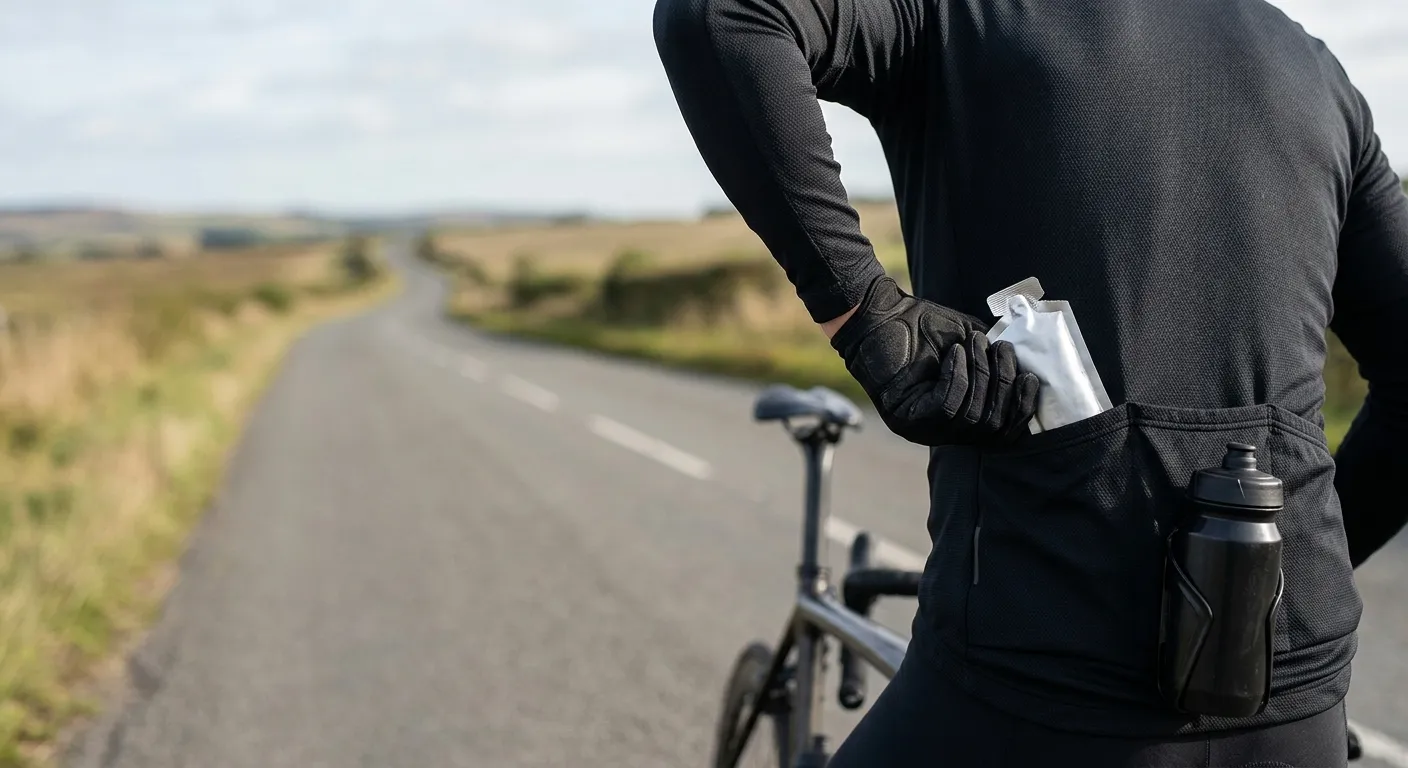
The real question is not "what is an energy gel?"
Nobody staring down a four-hour ride is wondering what an energy gel does. They are wondering how many to buy, how to space them out, and whether it is cheaper to lean on drink mix instead.
The simplest way to answer that is to start from total carbohydrate needed, then work backwards to a shopping list. Sports nutrition guidance generally lands in this range for ride duration:
| Ride length | Typical carb target | Total carbohydrate needed |
|---|---|---|
| 1-2 hours | 30-60g/hour | 30-120g |
| 2-3 hours | 60g/hour | 120-180g |
| 3-4 hours | 60-90g/hour | 180-360g |
| 4-5 hours | 80-100g/hour | 320-500g |
| 5-6+ hours | 90-120g/hour | 450-720g |
These are population-level ranges, not a prescription — gut tolerance, training status and heat all shift the practical number. They are, however, a far more useful starting point than picking gels because the flavour sounded nice.
Three ways to hit the number, not just gels
Gels are convenient, not compulsory. A sensible long-ride carb strategy usually blends three sources:
- Drink mix (roughly 40-90g carbs per bottle depending on concentration) — the easiest way to get a steady baseline without chewing.
- Gels (20-40g carbs each depending on brand) — quick top-ups, easy to eat while climbing or in traffic.
- Real food — bananas, rice cakes, malt loaf, dried fruit — cheaper per gram of carbohydrate and a break from sweetness, though slower to digest under hard effort.
A blend also spreads gut load across different absorption pathways instead of relying on one gel brand's formula for six straight hours.
Example combinations by carb target
Illustrative, not prescriptive — swap products for whatever you have already tested and tolerate. Costs are approximate UK retail and will vary with offers.
3-hour ride, 60g/hour (≈180g total)
1 bottle of drink mix (≈60g) + 3 standard gels (≈60g) + 1 banana (≈27g). Roughly £4-£6 of nutrition for the ride.
4-hour ride, 80g/hour (≈320g total)
2 bottles of drink mix (≈120g) + 2 high-carb gels like Beta Fuel (≈80g) + 2 standard gels (≈46g) + a rice cake or malt loaf portion (≈40g). Roughly £8-£11.
5-hour ride, 90g/hour (≈450g total)
3 bottles of drink mix (≈180g) + 4 high-carb gels (≈160g) + dried fruit and a rice cake (≈80g). Roughly £13-£17.
6-hour race day, 100-120g/hour (≈650g total)
3-4 bottles of drink mix (≈240g) + 6-7 high-carb gels (≈280g) + real food to close the gap. This end of the range needs gut training beforehand — do not attempt it cold on race day.
Cost per ride adds up faster than people expect
A single 6-hour day built entirely from premium hydrogel gels can run £15-£20 in gels alone. Swapping in drink mix and real food for a third of that carbohydrate typically cuts the bill by a third to a half without changing the total grams delivered. For riders doing this most weekends through a season, that difference is worth planning around rather than discovering at the till.
See best cheap energy gels for cycling style thinking applied at the drink-mix level too — the cheapest carbohydrate on a bike is usually a bottle of mix and a banana, not a sachet.
Long-ride fuelling questions
How many gels do I need for a 4-hour bike ride?
If gels are your only carb source at 80g/hour for 4 hours, that is roughly 320g of carbohydrate, or 8 standard 40g-carb gels. Most riders find it easier and cheaper to split that between drink mix, 3-4 gels and some real food.
Can I get too much carbohydrate on a long ride?
Yes — going straight to 90-120g/hour without any gut training is a common cause of stomach distress. Build up gradually in training rides before relying on a high carb rate for an event.
Is real food better than gels for long rides?
Neither is universally better. Real food is usually cheaper per gram of carbohydrate and a welcome break from sweetness, but digests more slowly and is harder to eat at high intensity. Most long-ride plans use both.
Related guides
Best energy gels for cycling
The full gel-by-gel comparison this page's combinations are built from.
What to eat and drink on a 100-mile ride
The same carb maths, laid out hour by hour for a specific distance.
Maurten vs SIS Beta Fuel
The two gels most often reached for once a ride needs 80g/hour or more.
Best electrolytes for heavy sweaters
Carbohydrate is only half of a long ride. Sodium is the other half.
Best electrolyte drinks for cycling
Pair a carb strategy with a hydration one from our original comparison.